

At Tuffa Workwear, protection doesn’t begin with a finished garment. It starts much earlier, in places most people never see, and with decisions that rarely make it onto a product label.
Because what ends up on site is only ever the result of what came before it. The fabric it’s made from. The way that fabric is engineered. The people who bring it to life. And the standards that sit behind every stage of that process.
When you trace it all the way back, you realise workwear is less about a single product and more about a chain of trust.
Where performance actually begins
Tuffa works with a European specialist manufacturer of technical protective fabrics, built around long-term collaboration rather than short-term supply. That relationship matters because fabric is not something you can “fix” later in the process. If it’s not right at the source, everything built on top of it inherits that limitation.
Our MULTITEK™ fabrics are developed for different applications depending on the end use, and are designed to meet internationally recognised standards such as ISO 11612 for heat and flame protection, ISO 11611 for welding, EN 1149-5 for anti-static performance, ASTM F1959 for arc flash protection, NFPA 2112 for flash fire, and AS/NZS 1906.4 for high-visibility requirements.
These standards provide a framework for performance, but they don’t fully explain what goes into the fabric itself. Just as important is how it is produced and what systems are in place around that production.
For that reason, our fabric partner also operates under ISO 14001 environmental management certification and OEKO-TEX STeP certification. These cover environmental impact, chemical use, worker health and safety, and broader responsibility across production systems.
It means the focus is not only on whether the fabric performs, but on how responsibly it is made before it ever becomes part of a garment.
The manufacturing layer most people don’t see
Once the fabric exists, the next stage is where it becomes something wearable, something that has to function in the real world under pressure, repetition, and time.
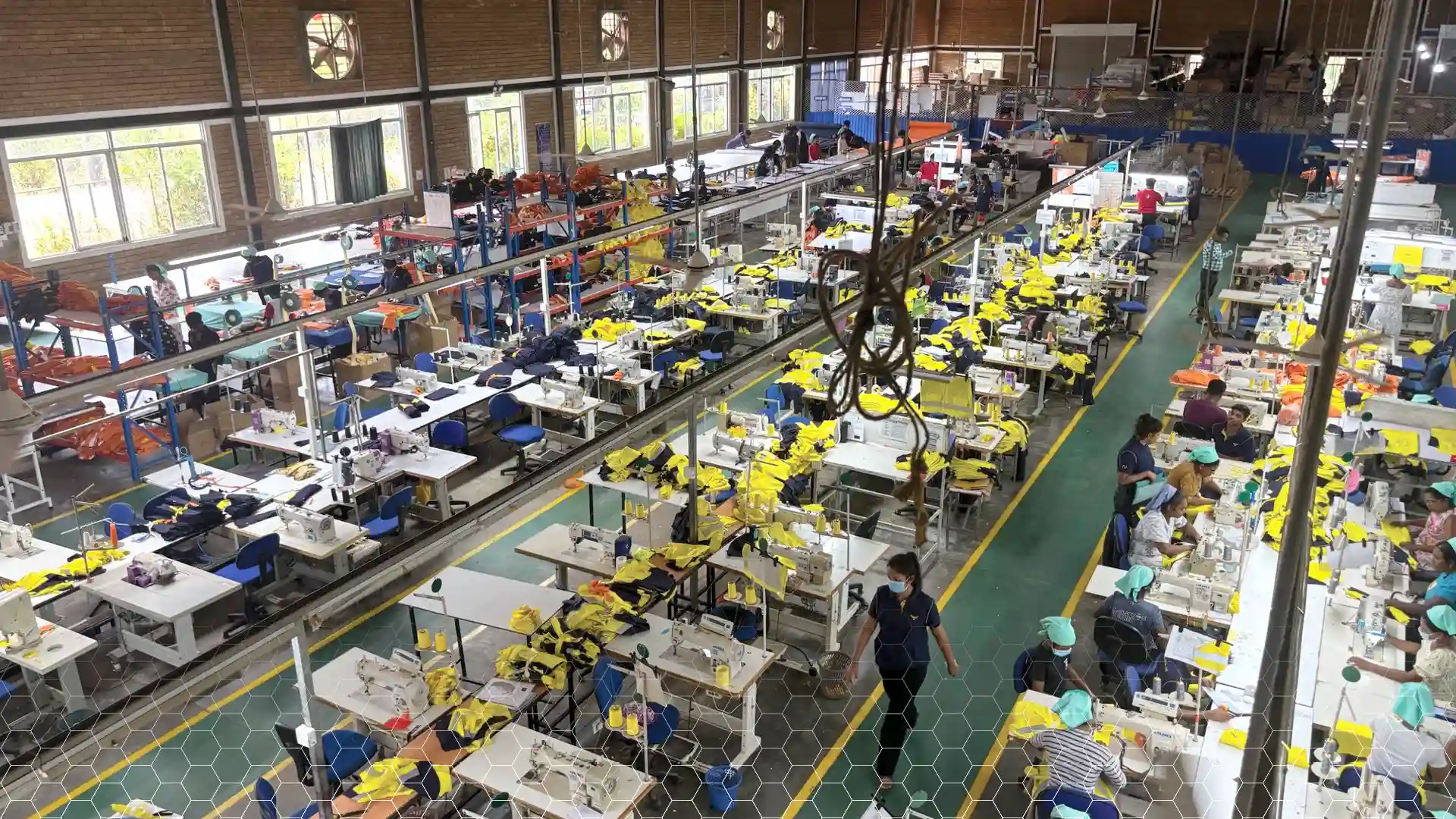
Our garments are manufactured in Sri Lanka through a long-standing partnership with a specialist workwear producer. It’s a relationship that has developed over more than 15 years, shaped by consistency rather than volume, and by a shared understanding of what “good” actually looks like in practice.
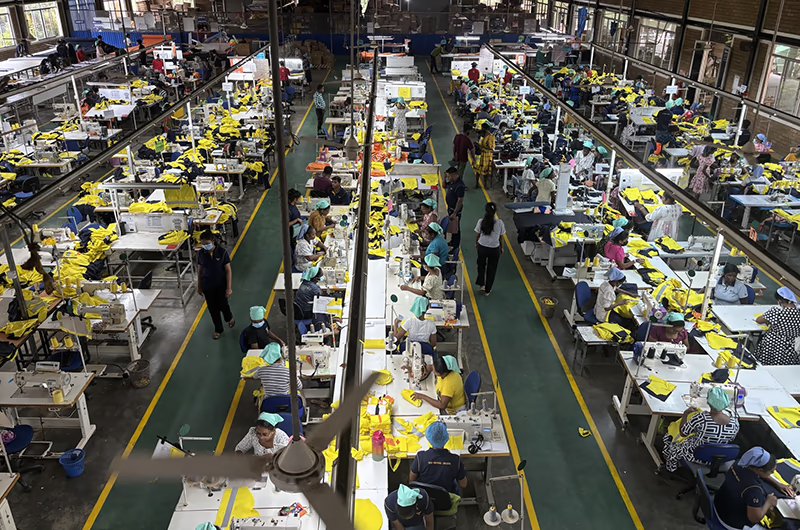
That consistency shows up in the details. In how garments hold their structure after repeated wear. In how sizing remains reliable across production runs. In how construction decisions are made with durability in mind, not just appearance on delivery.
It’s the kind of reliability that doesn’t happen by accident. It comes from working with the same people long enough to refine expectations and standards together.
That facility is also independently audited through SMETA (Sedex Members Ethical Trade Audit), conducted by SGS, alongside additional global frameworks including WRAP, BSCI, SLCP, HIGG and GRS.
While the terminology can feel technical, the intent behind it is straightforward. These audits assess how the facility operates day to day, not just what it produces. That includes labour conditions, workplace health and safety, environmental systems, and business ethics.
More specifically, they look at things that matter in a very practical sense. Whether workers are paid fairly and above legal minimum requirements. Whether there is access to on-site medical support. Whether fire safety training is properly implemented. Whether workers have representation. And whether there are clear, enforced protections against forced or child labour.
It is independent oversight that exists outside of brand language. External verification that remains in place regardless of claims or intent.
Bringing it together
When you step back, what we are really talking about is a system built on continuity.
Fabric developed by specialists who understand performance at a technical level. Garments made through a long-term manufacturing partnership that prioritises consistency. And independent audits that ensure standards are not just stated, but verified.
None of this replaces the final product. But it explains why the final product behaves the way it does.
Because trust in protective clothing is not created at the moment it is worn. It is built quietly, step by step, long before that moment arrives.
And when it works properly, it doesn’t need to draw attention to itself. It just does its job, so the person wearing it can focus on theirs.