
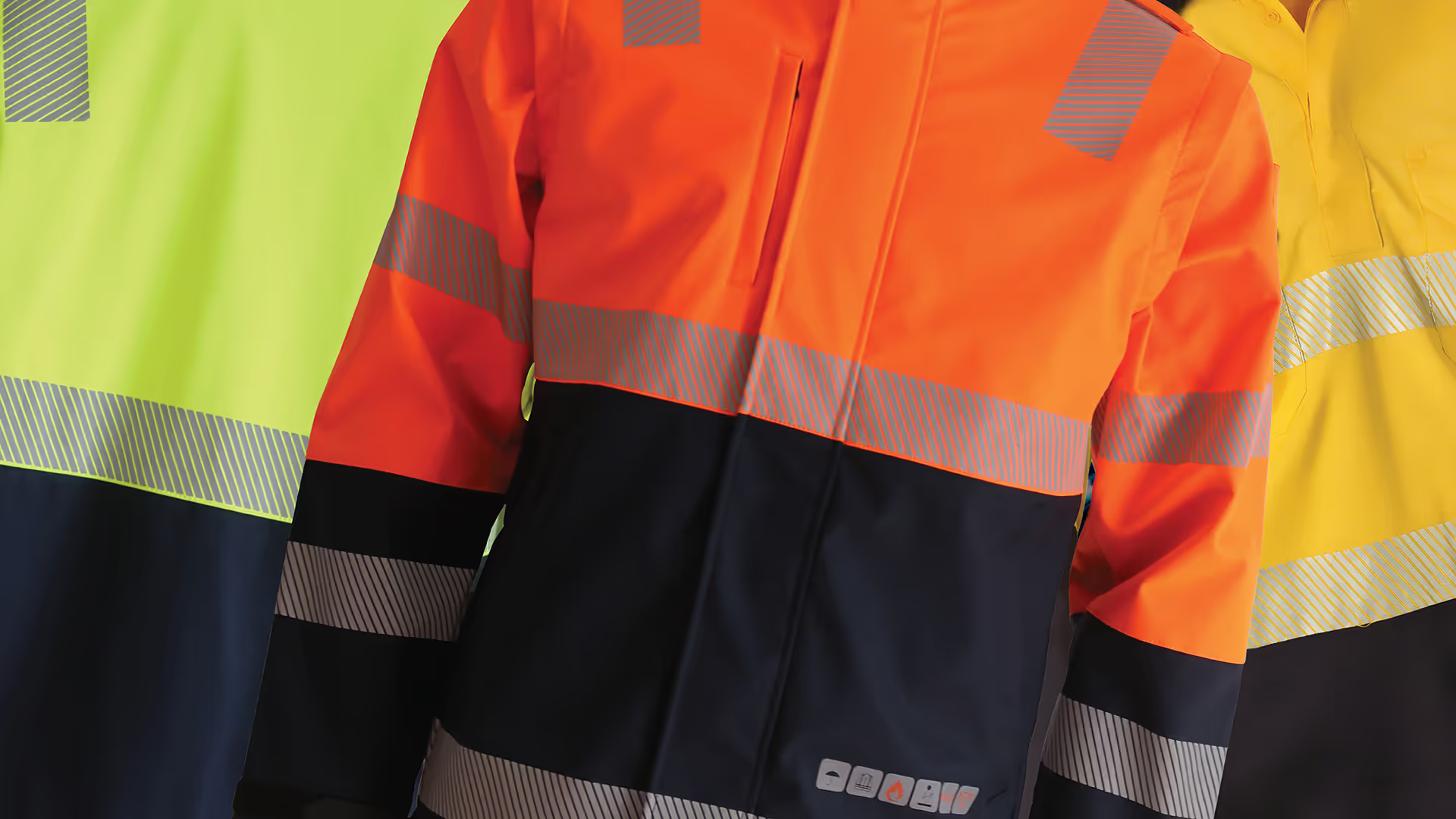

When you choose FR/ARC workwear, you're trusting that a garment will perform under conditions you hope you'll never face. That trust has to be earned somewhere. With MULTITEK™ by Tuffa Workwear, it starts at the fibre level.
Most FR workwear conversations focus on certification ratings and compliance categories. Those things matter. But behind every rating is a fabric - and the science of that fabric determines how well a garment actually protects, how comfortably a worker can wear it across a full shift, and whether its performance holds up over years of use.
MULTITEK™ is built around getting that part right.
Why inherent FR matters
Not all flame-resistant fabrics are created equal. Many rely on chemical treatments applied to the surface of a base fabric - an approach that works initially, but degrades with repeated laundering and wear. Over time, the protection diminishes. The garment may still carry its original certification, but its real-world performance is no longer what it was.
MULTITEK™ takes a different approach. Developed by Tuffa Workwear from a commitment to continuous improvement in FR/ARC-rated apparel, it is constructed from inherently flame-resistant fibres, meaning the protective properties are integrated at the molecular level during production, not applied after the fact. The flame resistance is part of the fibre itself. It cannot wash out. It does not degrade with wear. A MULTITEK™ garment performs to the same standard on its hundredth industrial wash as it does on day one.
For workers in electrical, mining, oil and gas, and energy environments, that consistency is not a technical footnote. It is the difference between PPE that maintains its compliance across its service life and PPE that only starts there.
The fibre blend: LENZING™ FR and aramid
MULTITEK™ is built on a precise blend of two complementary high-performance fibres.
LENZING™ FR is an inherently flame-resistant cellulosic fibre derived from sustainably managed wood sources. As a wood-based fibre, it brings with it the natural properties of cellulose - excellent moisture absorption, strong breathability, and a soft feel against the skin. These are not incidental benefits. In high-risk environments, heat stress and fatigue are genuine safety risks. LENZING™ FR actively supports the body's natural thermal regulation, helping manage perspiration and maintain comfort under load. A worker who is managing heat effectively maintains better focus, endurance, and decision-making - all of which matter when the job carries inherent hazard.
LENZING™ FR production also carries a significantly lower environmental footprint than conventional synthetic FR fibres. Tuffa Workwear's use of LENZING™ FR contributes to a reduction in environmental impact of up to 60% compared to standard alternatives.
Aramid provides the structural backbone. A high-performance synthetic fibre well established in protective clothing, aramid delivers exceptional heat resistance, tensile strength, and durability under abrasion. In MULTITEK™, aramid runs through both the fabric construction and the stitching thread - meaning every seam in a MULTITEK™ garment carries the same protective integrity as the fabric panels themselves. In real arc flash or flash fire scenarios, seam failure is a critical vulnerability in lesser garments. MULTITEK™ addresses that directly.
The blend balances long-lasting FR protection with comfort and wearability - two things that have traditionally been in tension in protective workwear.
Dual-weight construction
One of the more considered features of MULTITEK™ is its dual-weight fabric approach. Lighter fabric - typically 180gsm - is used in areas requiring breathability and freedom of movement, such as shirt and upper body construction. Heavier fabric - typically 250gsm - is used in lower body and sleeve zones where abrasion resistance and durability are the priority.
This is deliberate trade-off management. Maximum comfort where the worker needs it most. Maximum durability where the hazard exposure is highest.
Certified to the standards that count
Tuffa Workwear's MULTITEK™ garments are certified across the full range of standards relevant to the multi-hazard environments their customers work in: EN/ISO 11612 (flame resistance), NFPA 70E PPE 2 (arc flash protection), NFPA 2112 (flash fire), ASTM F1959 (arc rating), EN/ISO 1149-5 (anti-static), AS/NZS 4602.1 (hi-visibility day/night), and UPF 50+ sun protection.
Each of those certifications represents independent, tested validation — not marketing language. The standards provide a framework for what the garment must do. The fabric is what actually does it.
What it means in practice
FR/ARC workwear is not a commodity. The fabric behind a garment determines whether its certifications hold up in the real world, whether workers will wear it comfortably across a full shift, and whether it will maintain its protective properties over years of service.
MULTITEK™ was developed by Tuffa Workwear to close the gap between protection and wearability - the assumption that high-performing protective clothing must be heavy, uncomfortable, or intolerable in warm conditions. The LENZING™ FR and aramid blend challenges that assumption directly.
Because when a garment is comfortable, workers wear it properly. And when they wear it properly, it protects them the way it's supposed to.
Explore the full MULTITEK™ range in the new Tuffa Workwear Product Catalogue.
Ready to partner with Tuffa?
Whether you're sourcing protection for your workforce or looking to stock Australia's leading FR/ARC range, our specialists are ready to help with expert guidance and competitive solutions.